The Silent Culprit: How Lamination Stack Quality Dictates NVH in Passenger Vehicles
Have you ever ridden in an electric car and noticed that high-pitched whine? It’s a sound that can get on your nerves. You bought an electric vehicle (EV) for a quiet, smooth ride. But that humming and buzzing noise ruins the peace. This article will show you the hidden reason for that noise. It’s not the battery or the tires. The secret lies deep inside the electric motor, in something called the lamination stack. We will explain how the quality of these tiny metal parts makes the difference between a silent, luxury ride and an annoying one.
Table of Contents
- Why Is My New Electric Car So Whiny?
- What Really Makes an Electric Motor Hum and Vibrate?
- How Can Tiny Metal Plates Cause Such a Big Noise?
- What Happens When Laminations Aren’t Perfectly Flat?
- Can a Tiny Burr on a Lamination Really Matter?
- Does How You Squeeze the Stack Together Change the Sound?
- Stamping vs. Laser Cutting: Which Makes a Quieter Motor?
- How Does Sticking Laminations Together Help?
- How Can We Build a Quieter Motor from the Start?
- Why Should You Care About Lamination Quality?
Why Is My New Electric Car So Whiny?
You step into a brand-new EV. You expect silence. But as you speed up, a high-frequency whine fills the car. This is a huge problem for car makers like Tesla, Ford Motor Company, and General Motors (GM). The noise you hear is called Noise, Vibration, and Harshness, or NVH. In a gas car, the engine’s rumble covers up these little noises. But in a quiet EV, they stand out.
This isn’t just a minor annoyance. This electric motor NVH makes a car feel cheap. It can give you a headache. It makes people wonder if something is wrong with their expensive new car. This problem, this powertrain noise, often comes from one main place: the traction motor. And the quality of that motor is decided before it’s even built. The problem starts with the very bones of the motor core.
The cause of this humming and whining is often poor quality in the motor’s core components. Specifically, we’re talking about the lamination stack. When these parts are not made perfectly, the motor vibrates. These vibrations travel through the car’s body and create the sounds you hear. It’s a sign that precision was overlooked, and now the driving experience is paying the price.
What Really Makes an Electric Motor Hum and Vibrate?
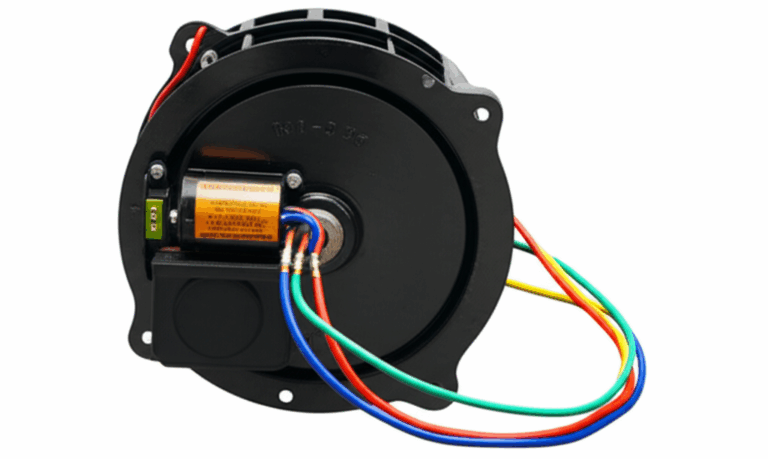
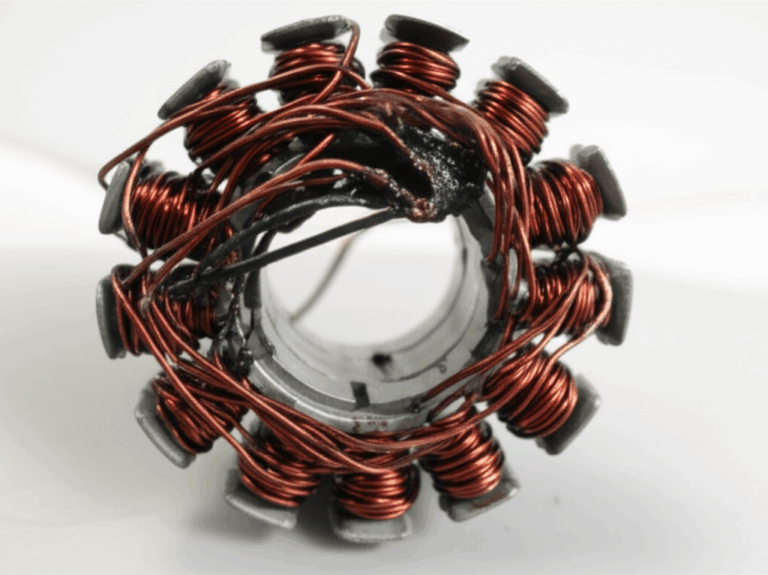
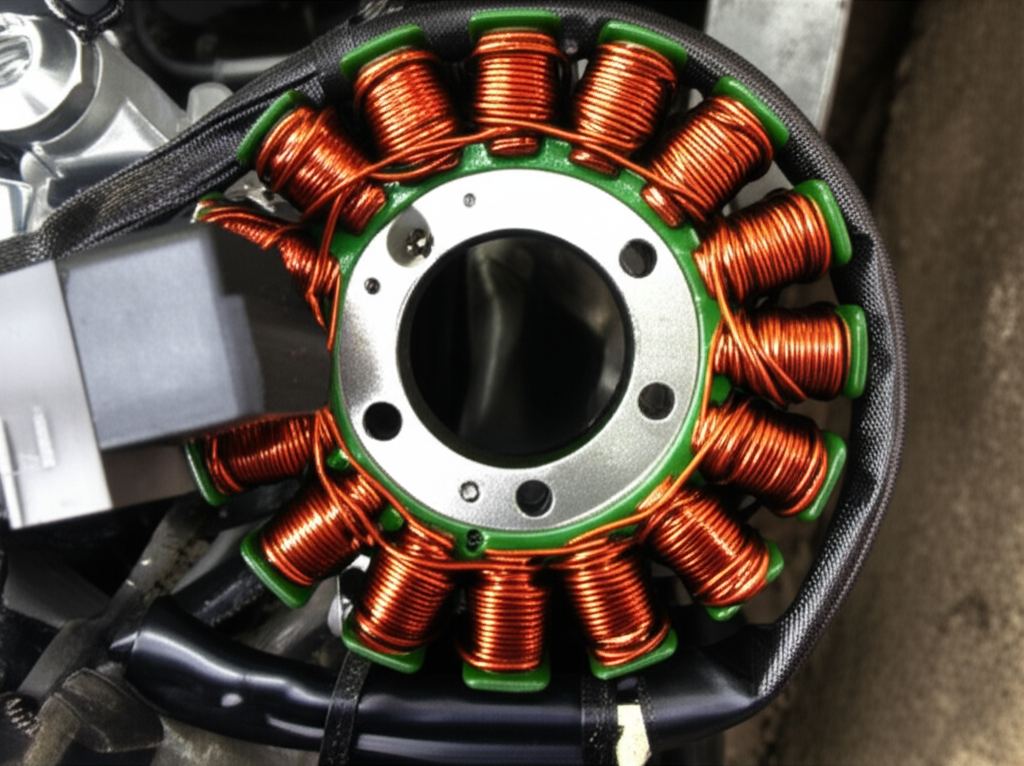
To understand the noise, you need to know how an electric motor works. It uses powerful magnets and electricity to create movement. Imagine a spinning top. A motor’s spinning part is called the rotor. The part that stays still is called the stator. Powerful electromagnetic forces spin the rotor.
But these forces don’t just spin the rotor. They also push and pull on the stator. They make it flex and bend, kind of like tapping on a drum. This creates vibrations. Engineers call these forces radial force and tangential force. When these forces change quickly, they create sound waves. This is a big source of the high-frequency motor whine in an EV.
There’s another sneaky cause of noise called magnetostriction. The metal plates inside the motor, called electrical steel laminations, actually change shape when magnets are turned on and off. They stretch and shrink just a tiny, tiny bit. But when this happens thousands of times a second, it creates a humming sound. It’s like a tiny speaker inside the motor itself, broadcasting noise.
How Can Tiny Metal Plates Cause Such a Big Noise?
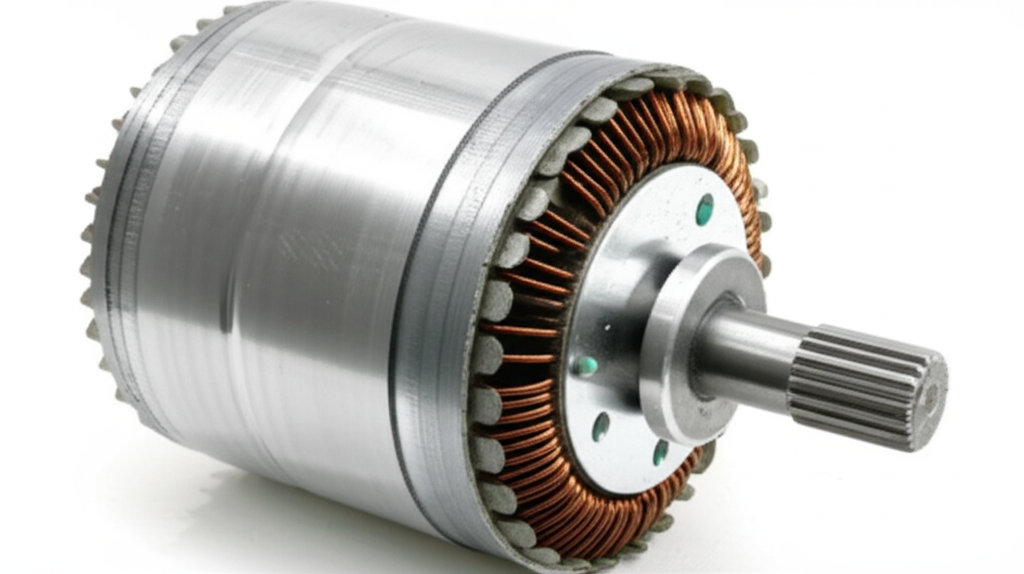
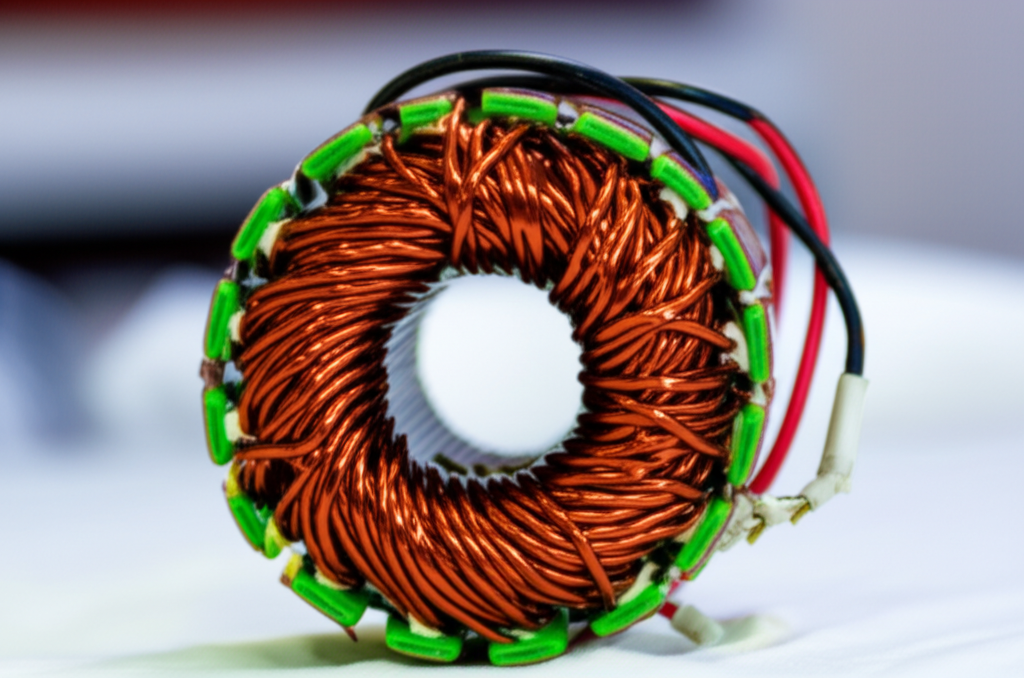
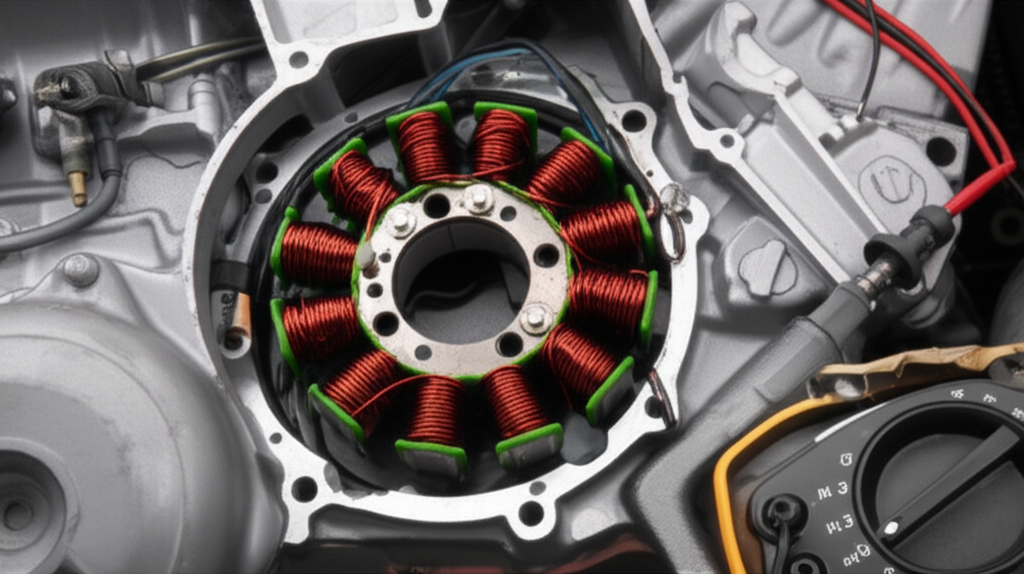
The heart of an electric motor is the lamination stack. Think of it like a deck of cards, but made of a special metal called silicon steel. Each card is a single lamination. Hundreds of these are stacked together to form the stator and rotor. These are the core lamination stacks that are so important. They guide the magnetic flux, which is the power that makes the motor spin.
Now, what if those cards were not perfect? What if some were bent? What if they had rough edges? They wouldn’t stack nicely. There would be gaps. The whole deck would be wobbly and weak. The same is true for a motor. When the lamination quality is poor, the whole motor suffers.
These tiny flaws have a huge impact on EV powertrain acoustics. They change the motor’s shape and strength. A poorly made stack can create uneven air gap effects. The air gap is the tiny space between the stator and rotor. If it’s not the same all the way around, the motor’s magnetic forces become unbalanced. This makes the motor shake and whine. This is why quality control for motor cores is not just a detail; it’s everything.
What Happens When Laminations Aren’t Perfectly Flat?
Let’s talk about one of the biggest troublemakers: bad dimensional accuracy. This means the laminations are not perfectly flat or have different thicknesses. Imagine stacking plates for dinner, but some are warped. The stack would lean and be unstable.
When laminations are not flat, they don’t sit flush against each other. This creates tiny air pockets in the stack. These pockets make the whole stator core weaker. A weaker core can’t resist the motor’s magnetic forces as well. It bends and deforms more easily. This bending is called stator ovalization mode, and it’s a huge source of vibration and noise.
Even a tiny lamination thickness variation can cause big problems. Let’s say one side of the stack is a hair thicker than the other. This tiny difference creates an Unbalanced Magnetic Pull (UMP). The rotor gets pulled harder to one side, leading to vibrations that you can feel and hear. According to simulations by software companies like Ansys, a thickness change of just 0.5% can increase these bad vibrations by over 10%. That’s a huge increase from a nearly invisible flaw.
Can a Tiny Burr on a Lamination Really Matter?
A burr is a small, rough edge of metal left over after a lamination is cut out. Think of the sharp bit left on a can after you use a can opener. In motor manufacturing, these burrs are a nightmare. They might be only 20 micrometers high—smaller than a human hair—but they can ruin a motor’s quiet performance.
Problem: When you stack laminations with burrs, the burrs touch each other. This creates a tiny electrical path between the laminations. The whole point of using separate laminations is to stop electricity from swirling around inside the core. These swirling currents are called eddy currents, and they waste energy and create heat. But worse, they also create their own magnetic fields that mess up the motor’s smooth operation.
Agitation: These unwanted magnetic fields generate radial force harmonics. Think of harmonics as extra, unwanted musical notes that make a clean sound messy and harsh. A case study showed that a burr of just 20 micrometers can increase the Sound Pressure Level (SPL) by 2-3 decibels (dB(A)). To your ear, that’s a very noticeable increase in noise. It’s the difference between a pleasant hum and an irritating whine. This is how a microscopic flaw leads to a macroscopic problem.
Does How You Squeeze the Stack Together Change the Sound?
Yes, absolutely. How you press the laminations together, known as stacking pressure, is very important. You can’t just press them together as hard as you can. You also can’t leave them too loose. The pressure changes the motor core stiffness. It also affects how well the stack can absorb vibrations, which is called damping.
Think of a guitar string. If it’s too loose, it makes a low, dull sound. If it’s too tight, it makes a high, sharp sound. The stator core is similar. Every object has a structural resonance, a frequency at which it loves to vibrate. If the motor’s magnetic forces happen to push at that exact frequency, the vibrations get much, much bigger. This is like pushing someone on a swing at just the right time to make them go higher.
By carefully controlling the stacking pressure, you can change the stator’s resonance frequency. Good manufacturers use Finite Element Analysis (FEA) to figure out the perfect pressure. They can “tune” the stator to make sure its resonance frequency doesn’t match the motor’s operating frequencies. A report from the FEV Group, an engineering company, showed that changing the pressure can shift this frequency by 5-10%. If that shift moves it away from a problem spot, the motor can become over 10 dB quieter. That’s the difference between shouting and talking.
Stamping vs. Laser Cutting: Which Makes a Quieter Motor?
There are two main ways to make laminations: stamping and laser cutting. Each has its pros and cons for NVH.
Stamping is like using a cookie cutter on a sheet of metal. It’s very fast and cheap, which is great for making lots of parts. However, the stamping process can create those nasty burrs we talked about. It also creates residual stress in the metal near the cut edge. This stress changes the metal’s magnetic properties and can increase magnetostriction noise. To fix this, some parts go through an annealing process, which is like baking the metal to relax it.
Laser cutting uses a high-power laser to melt and cut the shape. The good news is that it leaves a clean, burr-free edge. This leads to a better stacking factor (less air in the stack) and fewer electrical shorts. Research in IEEE publications has shown that laser-cut cores can be about 2 dB quieter than stamped ones. The downside? Laser cutting is much slower and more expensive. The choice between them is a trade-off between cost, speed, and the ultimate goal for quiet performance.
| Manufacturing Method | Pros for NVH | Cons for NVH | Best For |
|---|---|---|---|
| Stamping | Fast, low cost | Can create burrs, high residual stress | High-volume production where cost is key |
| Laser Cutting | Burr-free, low residual stress | Slower, higher cost, can have a Heat Affected Zone (HAZ) | Prototypes, high-performance motors where NVH is critical |
How Does Sticking Laminations Together Help?
Once the laminations are cut, you have to join them into a solid core. The method you use has a massive impact on NVH. Old methods like welding or interlocking (bending tabs of metal to hold them) can be bad for noise. Welding creates a hard spot that acts like a bridge for vibrations to travel. It’s an acoustic “hot spot.”
A much better way is to use a special adhesive. One of the best technologies is called Backlack. This is a special coating on the laminations that acts like a glue when it’s heated and pressed. This bonding process turns the whole stack of hundreds of individual plates into one solid, unified part.
A bonded stator core lamination is much stiffer and has better damping. The glue between each layer helps to deaden vibrations, like putting your hand on a ringing bell to quiet it. A study comparing a welded core to a Backlack bonded core found amazing results. The bonded core was 30% stiffer and had 50% better damping. This led to a 3-5 dB drop in the noise the motor made. For a premium EV, this is a game-changing improvement.
How Can We Build a Quieter Motor from the Start?
The best way to fix a noise problem is to prevent it from ever happening. Smart companies use e-motor design for low noise right from the beginning. This involves a lot of computer work before any metal is ever cut.
Engineers use powerful NVH simulation and analysis software from companies like Siemens or Altair. This software can predict how a motor will sound before it’s even built. They can test different shapes for the stator slot design or the rotor core lamination to see which one creates the fewest noise-causing vibrations. This is a part of Computer-Aided Engineering (CAE).
Another clever trick is called skewing. This means the laminations in the stack are slightly twisted, not perfectly aligned. This simple twist helps to cancel out some of the bad harmonics, like cogging torque, that cause noise at low speeds. It’s a design choice that directly helps with torque ripple reduction. By combining smart design with high-quality manufacturing, you can create a motor that is born to be quiet.
Why Should You Care About Lamination Quality?
At the end of the day, all this technical detail comes down to one thing: the customer experience. A quiet, smooth ride is what people expect from a modern EV. The high-pitched whine from a low-quality motor is a sign of poor engineering and manufacturing. It damages a brand’s reputation and can lead to costly warranty claims.
Focusing on the quality of the motor core laminations is not about spending more money. It’s about investing in the final product. It’s a direct investment in passenger comfort. When you choose a supplier that guarantees perfect flatness, no burrs, and uses advanced bonding techniques like Backlack, you are solving the NVH problem at its source.
The silent performance of an EV is a huge selling point. The companies that master this will be the winners in the market. And mastery starts with the smallest parts. It starts with a commitment to perfect electrical steel laminations, which are the foundation of every great electric motor. This precision manufacturing is the true key to a refined driving experience.
Key Takeaways to Remember:
- NVH is Critical: In quiet EVs, small motor noises like humming and whining become a huge problem for customer satisfaction.
- The Source is the Core: Most of this noise comes from vibrations in the motor’s stator, caused by electromagnetic forces and magnetostriction.
- Quality is Everything: The manufacturing quality of the lamination stack is the biggest factor in how much noise a motor makes.
- Tiny Flaws, Big Noise: Imperfections like burrs, uneven thickness, and poor flatness create vibrations that turn into audible noise. A 20µm burr can increase noise by 3 dB.
- Manufacturing Matters: How you cut (laser vs. stamping) and bond (Backlack vs. welding) the laminations dramatically changes the motor’s acoustic signature.
- Design for Silence: Using NVH simulation and smart design choices from the start is the most effective way to build a quiet motor.