How Tiny Changes in Motor Design Create Huge Results: Your Guide to Airgaps, Teeth, and Ribs
Have you ever tried to build something complex? Maybe a model airplane or a computer? You know that one tiny piece in the wrong place can make the whole thing fail. Electric motors are just like that but on a much bigger scale. As a motor designer, you face a huge challenge. You need to create a motor that is powerful, quiet, efficient, and strong. The problem is, changing one small part can have a ripple effect that changes everything else.
This guide is here to help. We’re going to pull back the curtain on three of the most critical parts of a motor: the airgap, the stator tooth width, and the rotor rib thickness. You’ll learn how a simple sensitivity analysis can save you from big headaches. Forget costly trial-and-error. By the end of this article, you’ll understand the trade-offs involved. You will be able to make smarter design choices for your Permanent Magnet Synchronous Motor (PMSM) from the very start.
Table of Contents
- Why Do Small Motor Parts Cause Such Big Headaches?
- What is Sensitivity Analysis, and How Does it Help?
- The Airgap: Why is the Space Between Parts So Important?
- Stator Teeth: How Do They Guide the Magic of Magnetism?
- Rotor Ribs: The Unsung Heroes of High-Speed Motors?
- Putting It All Together: A Simple Cheat Sheet
- How Can I Run My Own Sensitivity Study? A Quick 5-Step Guide
- What’s the Biggest Mistake Engineers Make with These Parts?
- So, How Do I Find the “Perfect” Design for My Motor?
- Your Top Questions Answered (FAQ)
- Final Thoughts: What to Remember
Why Do Small Motor Parts Cause Such Big Headaches?
Imagine spending months designing what you think is the perfect Interior Permanent Magnet (IPM) motor design. You’ve checked all your numbers. The motor geometry looks good on paper. You feel confident. So, you build a prototype, which costs a lot of time and money.
Then, the testing begins. Disaster! The motor is too loud, creating a terrible amount of acoustic noise and vibration (NVH). Or maybe it overheats because of high iron losses. Worse yet, it doesn’t produce the rated torque you promised. At high speeds, the centrifugal force is too much, and its structural integrity is at risk. You’re back to square one. This is a painful and expensive problem that can delay projects for months. It happens because motor design is a delicate balancing act. A single change to one parameter to fix one problem can create two new ones.
What is Sensitivity Analysis, and How Does it Help?
This is where sensitivity analysis comes to the rescue. Think of it as a “what if” game you play on a computer before you build anything real. It’s a method to see which parts of your design have the biggest impact on performance. You can ask the computer, “What if I make this gap a little bigger?” or “What if I make this part a little thicker?”
To do this, we use a powerful tool called Finite Element Analysis (FEA). Software like ANSYS Maxwell or JMAG creates a virtual prototype of your motor. This digital twin lets you test hundreds of design changes in just a few hours. A parametric sweep analysis automatically changes one part at a time and records the results. You can see exactly how each tiny change affects big things like torque density, motor efficiency optimization, and power factor. This approach turns a guessing game into a science. It helps you find the sweet spot for every part, leading to a much better final product.
The Airgap: Why is the Space Between Parts So Important?
The airgap is the tiny space between the spinning rotor and the stationary stator. It may seem like empty space, but it’s one of the most important parts of the motor’s magnetic circuit. The magnetic field has to jump across this gap to make the motor turn.
Think of it like two magnets. When they are very close, the pull is strong. When you pull them apart, the force gets weaker. The same is true for the airgap. A smaller airgap creates a stronger magnetic flux density, which generally leads to higher electromagnetic torque. This also improves the motor’s power factor. But there’s a catch.
A very small airgap can cause problems. It makes the cogging torque worse. This is the jerky feeling you get when the motor turns at low speed. A smaller gap also increases torque ripple, meaning the power delivery isn’t smooth. Furthermore, it requires very precise and expensive manufacturing. If the parts aren’t perfect, the rotor and stator could touch, destroying the motor. So, you have a trade-off: a small gap gives you more power, but a larger gap gives you a smoother, easier-to-build motor.
Stator Teeth: How Do They Guide the Magic of Magnetism?
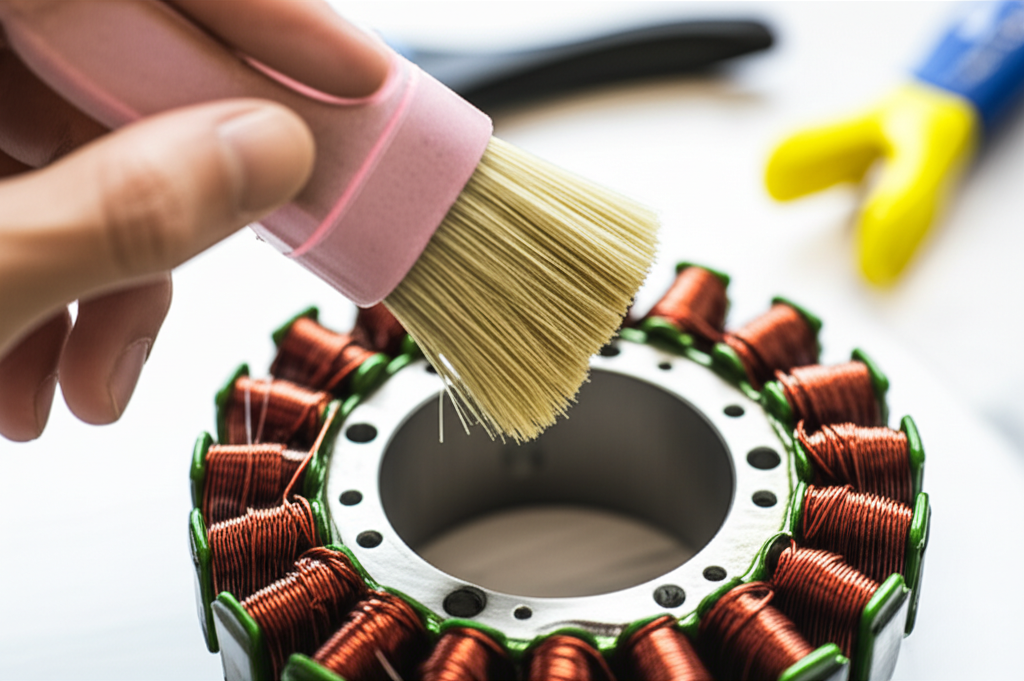
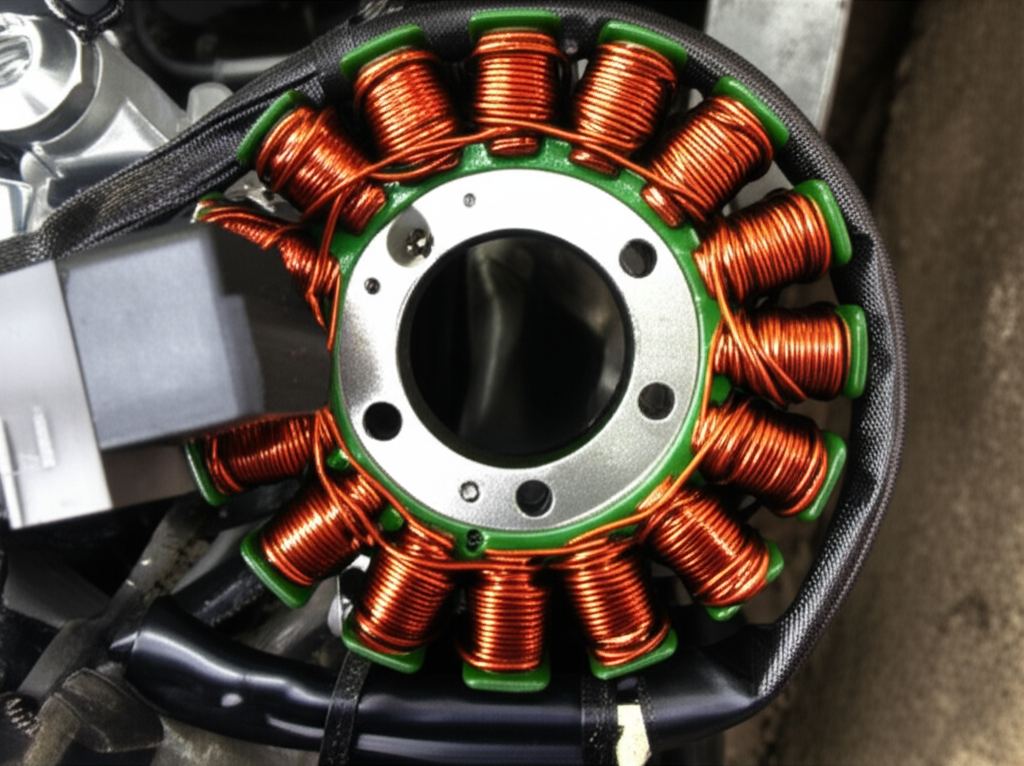
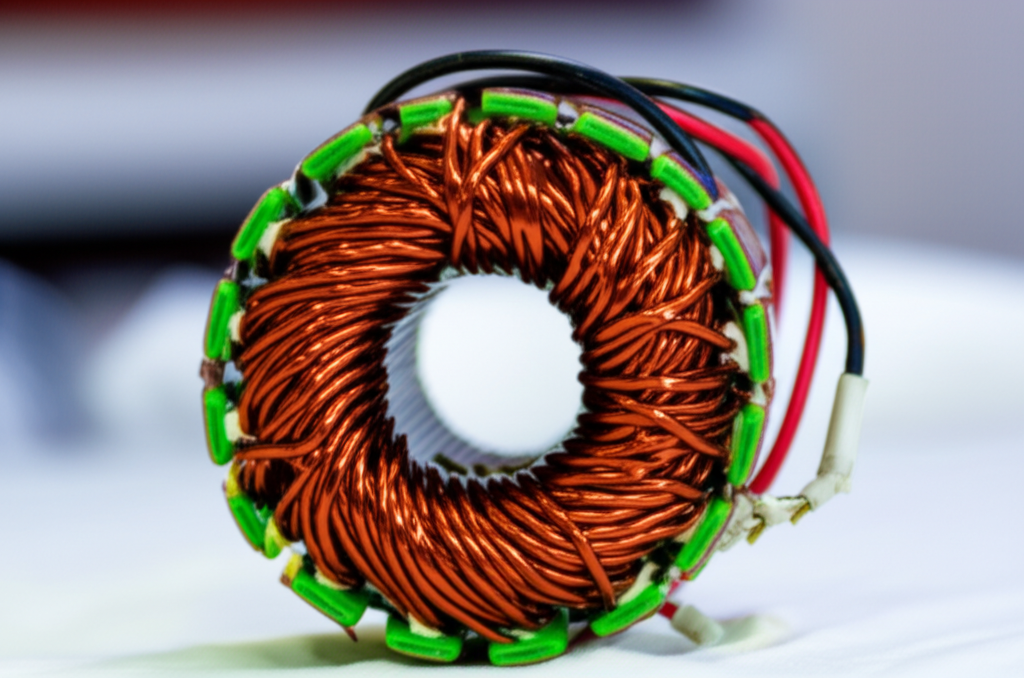
The stator is the part of the motor that doesn’t move. It has slots for the copper wires (winding configuration) and “teeth” between those slots. These stator teeth are like channels for the magnetic field. Their job is to guide the magnetic flux distribution from the stator yoke to the airgap.
The stator tooth width is a critical design choice. If the teeth are too thin, they can’t handle all the magnetic energy. This is called magnetic saturation. Imagine a pipe that is too small for the amount of water you’re trying to push through it. The water backs up and doesn’t flow well. When a tooth saturates, it limits the motor’s peak torque and increases core losses, which creates heat.
On the other hand, if you make the teeth too wide, you have less space in the slots for the copper windings. This means you can’t push as much electric current through the motor, which also limits its power. The goal is to find the perfect balance. You want a tooth wide enough to avoid stator tooth saturation but narrow enough to leave plenty of room for copper. Perfecting this balance is key to creating an efficient stator core lamination design.
Rotor Ribs: The Unsung Heroes of High-Speed Motors?
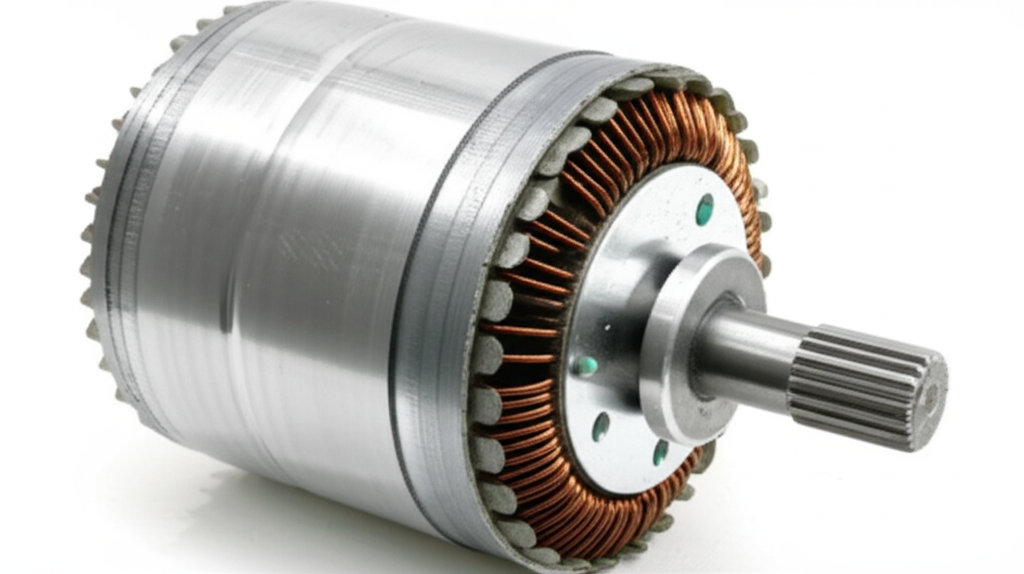
In an Interior Permanent Magnet (IPM) motor, the powerful Neodymium magnets (NdFeB) are buried inside the rotor. This design is great for high-speed motors, like those in an electric vehicle. But at high speeds, a huge centrifugal force tries to fling those magnets out of the rotor.
This is where rotor ribs come in. They are thin bridges of steel in the rotor topology that hold everything together. The rotor rib thickness has two very important and competing jobs. First, it must provide structural integrity. If the ribs are too thin, the rotor could break apart at high speeds. A mechanical stress analysis is needed to make sure the ribs are strong enough.
Second, the rib acts as a magnetic bridge. Unfortunately, this bridge creates a flux leakage path. Some of the magnetic energy from the magnets “leaks” across the rib instead of going across the airgap to do useful work. This leakage reduces the motor’s magnet torque. A thicker rib is stronger but leaks more magnetic flux. A thinner rib is weaker but is better for torque. This is a classic trade-off between mechanical strength and electromagnetic performance. The design of the rotor core lamination must carefully manage this balance.
Putting It All Together: A Simple Cheat Sheet
It can be hard to remember how all these parts affect each other. This table sums it up. It shows what happens when you make a change to one of these three key parameters.
| Parameter | Change | Effect on Average Torque | Effect on Torque Ripple / Cogging Torque | Effect on Other Key Metrics | Key Trade-Off / Comment |
|---|---|---|---|---|---|
| Airgap Length | Increase | Decreases (Significant) | Decreases (Significant) | Decreases Power Factor. Reduces risk of rotor-stator contact. Reduces back-EMF amplitude. | Performance vs. Manufacturability: A smaller airgap boosts performance but demands higher precision and cost. The primary trade-off is between torque density and torque quality (smoothness). |
| Airgap Length | Decrease | Increases (Significant) | Increases (Significant) | Improves Power Factor. Increases back-EMF amplitude. Higher risk of mechanical issues. | A common starting point for high-performance motors is an airgap between 0.5mm and 1.0mm. |
| Stator Tooth Width | Increase | Increases (Up to saturation point) | Can increase or decrease depending on design. | Decreases Copper Fill Factor (less space for windings). Reduces flux density in the tooth, lowering core losses if not oversized. | Magnetic vs. Electric Loading: The goal is to maximize flux without causing heavy saturation. Trade-off between iron path (tooth) and copper path (slot). |
| Stator Tooth Width | Decrease | Decreases (Due to early saturation) | Can increase or decrease depending on design. | Increases Copper Fill Factor. Increases flux density, leading to higher saturation and increased core losses. | Thinner teeth are a major source of performance limitation due to magnetic saturation, especially at peak torque. |
| Rotor Rib Thickness | Increase | Decreases (Slight to Moderate) | Can increase torque ripple. | Increases Structural Integrity (higher max speed). Increases q-axis Flux Leakage. Decreases saliency ratio (Lq/Ld), reducing reluctance torque. | Mechanical Strength vs. Electromagnetic Performance: This is the core trade-off for IPM motors. Thicker ribs are essential for high-speed operation but create a magnetic short-circuit that hurts torque output. |
| Rotor Rib Thickness | Decrease | Increases (Slight to Moderate) | Can decrease torque ripple. | Decreases Structural Integrity (lower max speed). Reduces q-axis Flux Leakage. Increases saliency ratio (Lq/Ld), improving reluctance torque. | For low-speed, high-torque applications, ribs can be made very thin or eliminated (using rib-less designs) to maximize torque. |
How Can I Run My Own Sensitivity Study? A Quick 5-Step Guide
You don’t need to be a computer genius to do your own basic sensitivity analysis. With modern FEA software, the process is straightforward. Here’s a simple workflow you can follow:
airgap from 0.5mm to 1.5mm in small steps. These are your input variables.average torque, torque ripple %, and efficiency.What’s the Biggest Mistake Engineers Make with These Parts?
The most common mistake is looking at each part by itself. An engineer might try to get the smallest airgap possible to maximize torque. But they forget that this will increase manufacturing cost and torque ripple. Another engineer might make the rotor ribs extra thick for safety, not realizing they are losing valuable torque due to flux leakage.
Great motor design is about seeing the big picture. It’s a multi-objective optimization problem. You can’t just maximize one thing. You have to balance competing goals. Do you need more power or a smoother ride? Is low cost more important than top-end efficiency? Sensitivity analysis helps you answer these questions with data, not just gut feelings. It helps you understand the motor as a complete system where every part affects every other part.
So, How Do I Find the “Perfect” Design for My Motor?
Here’s the secret: there is no single “perfect” design. The best design always depends on the job the motor needs to do. A motor for a high-speed electric vehicle needs very different features than a motor for a slow and steady industrial machine. The key is to understand the motor design trade-offs and make smart compromises.
Your goal is to find the “sweet spot” where you get the best possible performance for your specific needs. This means balancing torque, efficiency, cost, and strength. The analysis we’ve talked about gets you the right geometry. But the best design also requires the best materials. The performance of your magnetic circuit depends heavily on the quality of the electrical steel laminations you use. High-quality steel with low losses and predictable properties ensures that the amazing design you created on the computer works just as well in the real world. Without a solid foundation of materials, even the most optimized design will fail to deliver.
Your Top Questions Answered (FAQ)
Q1: How does airgap length directly affect cogging torque?
A: Think of the magnets on the rotor and the stator teeth as having preferred spots to line up. Cogging torque is the force that tries to pull them into these spots. A larger airgap weakens this magnetic pulling force. This smooths out the interaction between the magnets and teeth, which reduces the “jerkiness” of cogging torque.
Q2: What is the main risk of making rotor ribs too thin in an IPM motor?
A: The number one risk is mechanical failure. As the motor spins faster and faster, the centrifugal force trying to rip the rotor apart grows very quickly. If the ribs are too thin, they won’t have the yield strength to hold the rotor together. This can cause the rotor to bend or even break, which would destroy the motor.
Q3: Can tooth width be optimized to reduce torque ripple?
A: Yes, absolutely. Torque ripple is caused by small, repeating variations in the magnetic field as the motor turns. The shape and width of the stator teeth, along with the slot opening, have a big influence on the shape of this field. By carefully tuning the tooth width, you can cancel out some of the specific “harmonics” or vibrations that cause torque ripple, leading to smoother operation. This is a key part of harmonics analysis in motor design.
Final Thoughts: What to Remember
Designing a high-performance electric motor is a complex but rewarding challenge. By focusing on sensitivity analysis, you can take the guesswork out of the process.
Here are the key things to remember:
- Everything is a Trade-Off: Motor design is a balancing act. Improving one thing, like strength, might slightly reduce another, like torque.
- The Airgap is Critical: It controls the main trade-off between raw power (torque density) and smooth operation (torque ripple).
- Stator Teeth Channel Power: They must be wide enough to avoid magnetic saturation but narrow enough to leave room for copper windings.
- Rotor Ribs are a Compromise: They provide the strength needed for high speeds but can create a magnetic leak that reduces torque.
- Analyze Before You Build: Use FEA software to run a sensitivity analysis. This will save you huge amounts of time and money by preventing costly mistakes with physical prototypes.
- Quality Materials Matter: The best design in the world won’t work without high-quality components. Investing in premium motor core laminations ensures your final product performs as well as your simulations predict.