Can Self-Bonding Electrical Steel Reduce Motor Core Losses and Noise?
Short answer. Yes. In many motors self-bonding electrical steel can cut core losses and lower noise. In this guide I show you how it works, where it helps most, and what numbers you can expect. You will see how to boost motor efficiency, power density, and NVH. If you design, buy, or run motors you will find real value here.
Table of Contents
- What are motor core losses and why should you care?
- How do hysteresis and eddy current losses hurt efficiency?
- What problems come from traditional core assembly?
- What is self-bonding electrical steel?
- What key properties matter in self-bonding coatings?
- How does self-bonding cut eddy currents and parasitic losses?
- Can bonding lower hysteresis and stress-induced losses?
- How does bonding reduce noise and vibration in EV and industry?
- Where does this help most: EVs, high-speed, and more?
- Data and case studies: What numbers should you expect?
- What should you watch in manufacturing and quality control?
- What is the future of electrical steel and bonded stacks?
- How we can help you pick the right laminations and cores
- FAQ
- Key takeaways
What are motor core losses and why should you care?
Here is the problem. Core loss steals power inside your stator and rotor. It turns electricity into heat. You pay for it in watts per kilogram. You lose torque and efficiency. The motor runs hot and loud. You get less range in an EV and higher energy bills in a plant.
Two main loss types do the damage. Eddy current loss and hysteresis loss. Eddy currents are little loops of current that flow in each lamination. Hysteresis loss comes from the flip of magnetic domains each time the frequency changes. Both rise with frequency in hertz. Both grow with flux density in tesla. Both show up as heat and a higher watt per kilogram number.
I learned this on a shop floor. A motor looked fine on paper yet ran hot at speed. Efficiency fell off a cliff. Core loss was the silent thief. When we fixed lamination insulation and stress we saw big gains. You can too.
How do hysteresis and eddy current losses hurt efficiency?
Eddy current losses scale with frequency squared and lamination thickness. Think of them like tiny whirlpools in a river. If the water moves fast they churn harder. If the river is wide they spread. We stop them with electrical resistivity and thin laminations.
Hysteresis loss follows the B-H loop. Each cycle flips magnetic domains. If the steel has stress or poor magnetic properties the loop area grows. That wastes energy each cycle. It raises the watt per kilogram number. It heats up the core and hurts thermal management.
Add high-speed duty and the plot thickens. At high frequency dynamic core losses jump. Skin effects grow. In PMSM and induction motors this tax can be huge. Good electrical steel grades help. So does a better stack build.
What problems come from traditional core assembly?
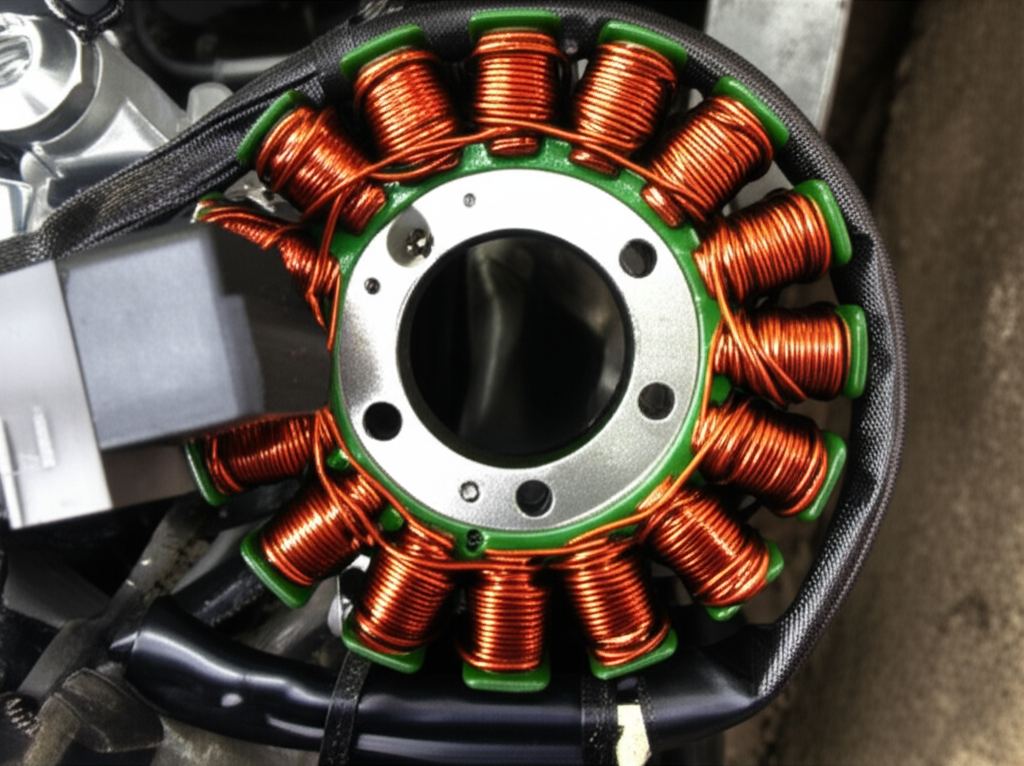
Traditional stacks often use welding, riveting, or mechanical interlocking. These methods can nick or bridge laminations. They can crush the insulation coating. They can leave low inter-lamina resistance. They can cause local hot spots and more eddy current paths.
Welds add stress. Stress changes magnetic domains and causes magnetic anisotropy. That can raise hysteresis loss and magnetostriction. It can also make the core buzz. I have seen a welded stator hum like a bee. The NVH was bad at certain resonance modes.
Air gaps and micro-movements between laminations create buzz and rattle. Loose stacks can shift under electromagnetic forces. You hear it as acoustic noise in decibels. You feel it as vibration. NVH (Noise, Vibration, Harshness) matters in EVs and in high-speed machines.
What is self-bonding electrical steel?
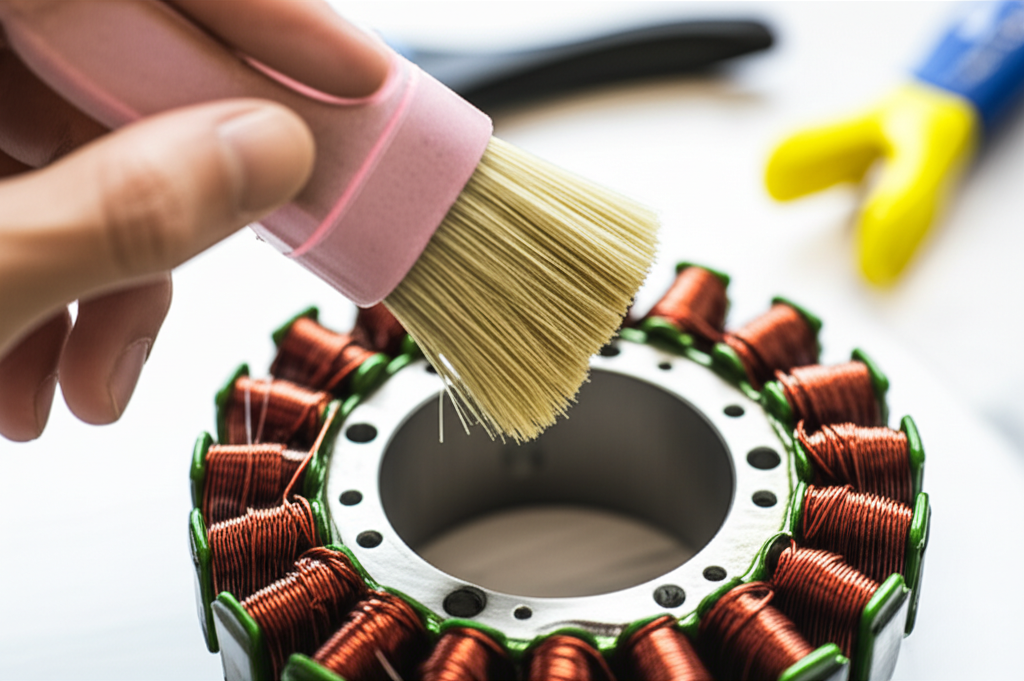
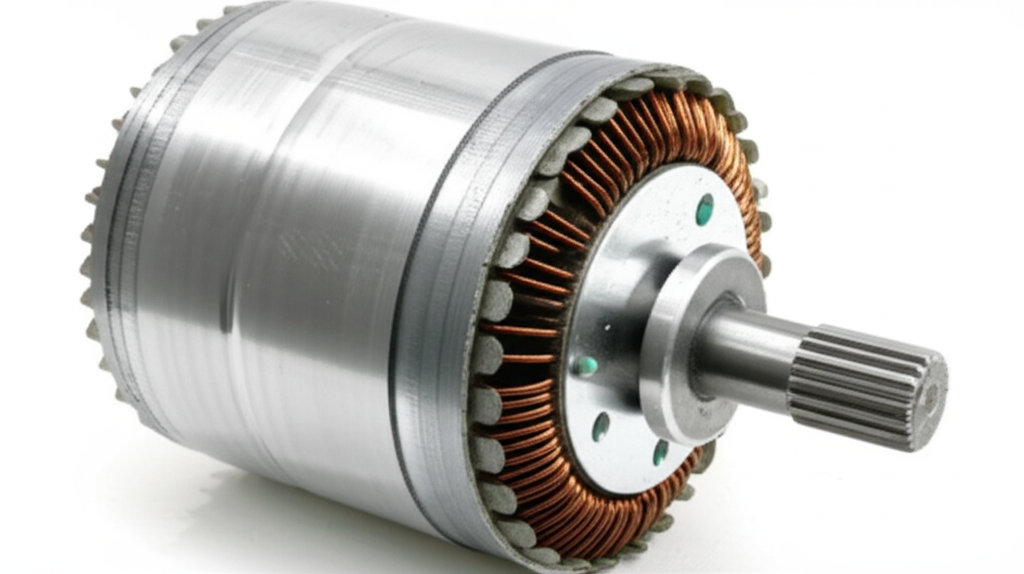
Self-bonding electrical steel is regular electrical steel with a special adhesive layer. The coating is heat-activated. During stack build you add heat and pressure. The sheets bond to each other across the whole face. You get a clean bonded stack.
The process is simple. Punch or laser the laminations. Stack them. Apply controlled heat and pressure. The adhesive cures. The bonded stack holds like a solid block. No welding. No rivets. No interlocking tabs. The result is a neat stator or rotor core that stays tight.
I like it because it solves two problems at once. It boosts inter-lamina resistance and it adds stiffness. Less current leaks between layers. Less movement happens in the stack. You get lower losses and lower noise in one go.
What key properties matter in self-bonding coatings?
Three properties drive performance. Electrical insulation, mechanical strength, and thermal stability.
- Electrical insulation: A good adhesive raises inter-lamina resistance. That cuts circulating currents. It keeps eddy losses down. Surface insulation resistance can be high and stable after heat cycles.
- Mechanical strength: A bonded stack acts like a monolith. It fights micro-slip and reduces vibration amplitude. Core rigidity and stiffness can increase by 20–50%. That helps NVH and durability.
- Thermal stability: The coating must hold up under heat. Motors see hot spots and cycling. The adhesive layer thickness must stay even. It should resist stress relaxation and keep bond integrity.
Fine details matter. Adhesive layer thickness affects stacking factor and heat paths. Coating adhesion strength defines durability. Void content should be low. Good material suppliers track these with quality control.
How does self-bonding cut eddy currents and parasitic losses?
The coating is a superior electrical insulator across laminations. It raises the resistance between sheets. That blocks inter-lamina current paths. With high resistivity you slash eddy currents. At higher frequency the benefit grows.
Studies and supplier data show up to 30% reduction in eddy current loss in some cases. The exact number depends on frequency, flux density, lamination thickness, and the quality of the adhesive. Better coating uniformity means better loss reduction at high speed.
You also reduce parasitic losses from burrs or small bridges. Bonding floods the interface and fills micro-gaps. That helps inter-lamina resistance. It stops tiny arcs and prevents localized heating. The result is a cooler core and a lower total W/kg number.
Can bonding lower hysteresis and stress-induced losses?
Yes in many builds. Welding and riveting can add stress and distort grains. Bonding uses pressure and heat without hard mechanical joints. That can reduce stress-induced magnetic anisotropy. It helps keep magnetic domains uniform.
Lower stress can trim hysteresis loss by 1–5% in some tests. This is modest yet real. Add that to the big eddy current drop and you get a solid total core loss reduction. In PMSM, SRM, and induction motors that adds up to more efficiency and torque.
Bonding can also lower magnetostriction effects. Magnetostriction is tiny change in size when the steel magnetizes. It can make noise. With less stress and better domain alignment you can cut the source of that hum. Quieter is better for EVs and for high-end industrial drives.
How does bonding reduce noise and vibration in EV and industry?
Noise often comes from two places. Electromagnetic forces and mechanical movement. Bonding helps with both. A solid, monolithic bonded stack eliminates micro-movements between laminations. Air gaps and slip points vanish. That reduces structural vibration.
Next comes damping. The adhesive layer adds damping at the interface. It acts like a thin cushion. It soaks up some energy from vibration modes. Tests report up to 20–40% lower vibration amplitude in some modes. Less structure-borne noise means fewer dB at the ear.
This is big for NVH in electric vehicles. Acoustic noise in EV motors stands out because there is no engine roar to mask it. Cutting 3–10 dB can feel two times to ten times quieter to people. In pumps and fans it reduces harshness. In aerospace and robotics it boosts user comfort and precision.
Where does this help most: EVs, high-speed, and more?
- Electric Vehicles (EVs): Lower core loss means more motor efficiency. That means extended range and lower heat. Quieter operation lifts the NVH score. In traction motors you want every watt back.
- High-speed motors: Frequency goes up. High frequency core losses explode. Bonded laminations cut eddy currents and dynamic core losses. You can push higher power density safely.
- Industrial motors: Long duty cycles punish poor builds. Bonded stacks save energy and reduce heat generation. Energy savings lower lifecycle cost of electric motors. Predictive maintenance likes cooler machines.
- Aerospace and robotics: Weight and performance matter. Better thermal management and higher torque density allow smaller, lighter motors. Bonded stacks boost mechanical integrity under dynamic loading.
- Generators and transformers: Self-bonding ideas carry over. In some transformer or generator cores improved inter-lamina resistance and low noise matter as well.
You can use this tech with non-oriented electrical steel (NOES) and also with grain-oriented electrical steel (GOES) in some applications. Work with suppliers on grade selection and coating class per IEC or ASTM standards.
Data and case studies: What numbers should you expect?
The table below sums up typical findings reported by suppliers, labs, and OEM tests. Your result will vary with grade, flux density, frequency, magnet design, and build precision.
| Feature / Metric | Traditional Laminated Core (Welded/Riveted) | Self-Bonding Electrical Steel Core (Bonded) | Observed Improvement / Impact | Source/Context |
|---|---|---|---|---|
| Core Loss Reduction | Baseline 10–15 W/kg at 1.5 T, 50 Hz | About 5–20% reduction | Energy savings rise at higher frequencies | Material suppliers and research |
| Eddy Current Losses | Higher due to contact paths | Up to 30% reduction | Depends on coating quality and thickness | University and supplier data |
| Hysteresis Losses | Higher with stress from welds | 1–5% reduction | Less stress and better magnetic uniformity | FEA and experiments |
| Motor Noise (Acoustic) | 70–85 dB typical EV motor | 3–10 dB reduction | Smoother NVH and less harshness | OEM NVH tests |
| Vibration Amplitude | Higher from micro-movement | 20–40% reduction in modes | Less resonance and better integrity | Vibration analysis |
| Core Rigidity / Stiffness | Lower due to discrete layers | 20–50% increase | Monolithic behavior under load | Mechanical testing |
| Stacking Factor | 0.95–0.98 | 0.96–0.99 | Better fill factor and fewer fasteners | Manufacturing data |
| Manufacturing Process | Welding and riveting | Heat-press bonding | Up to 30% shorter assembly time | Production reports |
| Thermal Performance | Hot spots at contact points | More uniform heat paths | Better cooling and longer life | Thermal imaging |
| Power Density | Standard | 5–15% increase | Better efficiency and thermal margin | Motor benchmarks |
I have seen similar ranges across traction motors, BLDC drives, and induction machines. At high speed the gap widens. At low speed the benefit still shows. Always measure core loss density at your target flux and frequency. Use a proper test rig per IEC or ASTM.
What should you watch in manufacturing and quality control?
Manufacturing sets the ceiling. Here is how to meet the need.
- Control heat and pressure during bonding: Follow the coating cure window. Too little heat or pressure can leave voids. Too much can cause squeeze-out and thin spots.
- Manage adhesive layer thickness: Keep it uniform. Balance stacking factor and insulation. Thicker is not always better for thermal paths.
- Keep burrs down: Good punching and forming reduce shorting across layers. Laser cutting may help. Use proper deburring.
- Check surface insulation resistance: Verify before and after heat treatment. Track changes through your process.
- Inspect bond quality: Check adhesion strength and void content. Use sectioning or ultrasound if needed. Monitor stress relaxation after thermal cycles.
- Validate magnetic performance: Measure flux density, permeability, and loss curves. Align with your FEA model and simulation software. Update your core loss modeling and simulation.
Quality control builds trust. Use IEC and ASTM standards. Work with material suppliers like ThyssenKrupp and JFE Steel on coating class and test methods. Document results and tie them to your NVH and motor acoustics testing.
What is the future of electrical steel and bonded stacks?
Self-bonding coatings keep getting better. New chemistries boost resistivity and thermal stability. Smart manufacturing adds sensors and closed-loop control for cure steps. Expect tighter quality and more repeatable bonding.
Motor designs push toward higher torque density and power density. That means higher frequency and higher flux. You need materials that hold up. Advanced electrical steel materials with finer grains and tailored coatings will play a bigger role. Core loss vs frequency will drive grade choice.
You will see more bonded stacks in EV traction motors, pumps, fans, and compact motors. Cooling will improve with advanced motor cooling paths and better thermal interfaces. The next wave ties materials, FEA, rotor dynamics, and NVH in one loop for fast design optimization.
How we can help you pick the right laminations and cores
Problem: You need lower core loss and less noise. Your schedule is tight. Your budget has limits.
Agitate: Heat and noise raise warranty risk. Energy waste hurts TCO. Late fixes blow timelines.
Solution: Choose proven laminations and bonded stacks from a trusted source. We can help you select grade, thickness, and coating for your use. We can align on punching, stacking factor, and cure steps. We can review your FEA and NVH targets.
- If you want a fast overview of options start with high quality electrical steel laminations.
- For full assemblies and custom stacks see our production of precision motor core laminations.
- Working on stators for PMSM, BLDC, or SRM Our team builds tight-tolerance stator core lamination packs that bond clean.
- Need rotors that hold up at speed We deliver balanced and bonded rotor core lamination sets with low runout.
We support NOES and GOES. We handle silicon steel and advanced non-oriented grades. We can prepare self-bonding coatings suited to your cure window and thermal profile. We test stacking factor, adhesion strength, and surface insulation resistance. We help you reach efficiency standards for motors and meet your NVH goals.
FAQ
Q: Can self-bonding reduce core loss in all motor types
A: Yes in most. PMSM, induction motors, and switched reluctance motors all benefit. Gains vary with frequency and flux density.
Q: Will bonding always reduce noise
A: It reduces many sources of buzz from loose laminations. It also adds damping. You still need good rotor dynamics and structural design.
Q: Does bonding raise cost
A: Coated steel can cost more per kg. You often save on assembly time and tooling. Many teams report lower total cost at scale.
Q: How do I measure the benefit
A: Measure W/kg at your target tesla and hertz. Run NVH tests across your speed range. Use accelerometers and microphones. Compare bonded vs welded.
Q: What about thermal limits
A: Use a coating rated for your max temperature. Verify adhesion and insulation after heat cycles.
Key takeaways
- Self-bonding electrical steel raises inter-lamina resistance and cuts eddy currents.
- Lower stress can reduce hysteresis loss and magnetostriction.
- Bonded stacks boost core rigidity and damping which lowers NVH.
- Expect 5–20% total core loss reduction and 3–10 dB less noise in many builds.
- Control heat, pressure, and coating thickness to get repeatable results.
- Use FEA and real tests to validate flux density, permeability, and loss.
- Work with trusted suppliers to pick the right grade and coating class.
References
- ThyssenKrupp Electrical Steel, product datasheets and application notes on self-bonding coatings.
- JFE Steel, non-oriented electrical steel specifications and lamination bonding guidelines.
- IEC 60034 series, rotating electrical machines efficiency and test methods.
- ASTM A976, classification of insulation coatings on electrical steel.
- Academic research on eddy current suppression, stress-induced losses, and magnetostriction in bonded laminations.
- OEM NVH testing reports and vibration analysis for electric traction motors.
Outline of This Article
- What are motor core losses and why should you care
- How do hysteresis and eddy current losses hurt efficiency
- What problems come from traditional core assembly
- What is self-bonding electrical steel
- What key properties matter in self-bonding coatings
- How does self-bonding cut eddy currents and parasitic losses
- Can bonding lower hysteresis and stress-induced losses
- How does bonding reduce noise and vibration in EV and industry
- Where does this help most EVs high-speed and more
- Data and case studies What numbers should you expect
- What should you watch in manufacturing and quality control
- What is the future of electrical steel and bonded stacks
- How we can help you pick the right laminations and cores
Deep dive on essential terms and how they matter to you
I promised simple language. I also promised depth. Here is a quick tour of key ideas you will meet when you spec a bonded core for a design review.
- Material selection for motor cores: Pick a grade with low iron losses and enough strength for forming and punching. Silicon steel and advanced NOES grades shine in motors.
- Surface insulation coatings: The bond coat must deliver high surface insulation resistance. It blocks inter-lamina current flow. It must also cure well under your process.
- Stacking factor: Higher is better for power density. Bonding often removes room used by welds or rivets. That can lift your stacking factor a bit.
- Flux density and saturation: Stay below magnetic saturation. Use FEA to map magnetic flux in tesla. Watch hot spots near teeth and slots.
- Core loss vs frequency: Loss grows with frequency. High-speed motors feel this hard. Bonding helps you manage high frequency core losses and dynamic core losses.
- Magnetostriction and acoustic emissions: Less stress means less magnetostriction. That reduces acoustic radiation from the core.
- Structural vibration and resonance: A bonded stack changes resonance in motor structures. That can move modes away from operating bands.
- Thermal management: Better contact between layers promotes even heat paths. Combined with advanced motor cooling you can push higher torque density.
Real-world design notes I share with teams
- PMSM and BLDC: Bonded stacks help with ripple torque and slot noise. They also help when you drive at high electrical frequency.
- Induction motors: Rotor lamination quality matters. Bonded rotors hold shape and can reduce rotor bar buzz.
- SRM: These motors can be loud. Bonded stacks help but you still need careful current shaping and structure.
- EV traction motors: NVH is king. Bonding reduces the “buzz” from laminations and helps with harshness.
- Pumps and fans: A quieter motor can win bids. Energy savings also improve lifecycle cost.
- Aerospace and robotics: Every gram counts. Higher power density with stable NVH gives you an edge.
Numbers you can show your boss
- Iron losses lowered by 5–20% in many cases.
- Eddy current losses down as much as 30% with the right coating.
- Hysteresis trimmed 1–5% by reducing stress.
- Noise down 3–10 dB which feels far quieter.
- Vibration amplitude reduced by up to 20–40% in specific modes.
- Assembly time cut up to 30% when you remove welding and riveting steps.
These are typical ranges reported by material suppliers and OEM case studies. Always test against your design because frequency, flux, and lamination thickness change the outcome.
Compliance, testing, and documentation
You want proof. So do your customers. Here is how to build it fast.
- Use IEC or ASTM methods to measure W/kg at defined T and Hz.
- Log decibels across the operating speed range. Break out motor acoustics testing and the noise spectrum for root cause analysis.
- Validate permeability and resistivity on incoming lots. Track batch-to-batch changes.
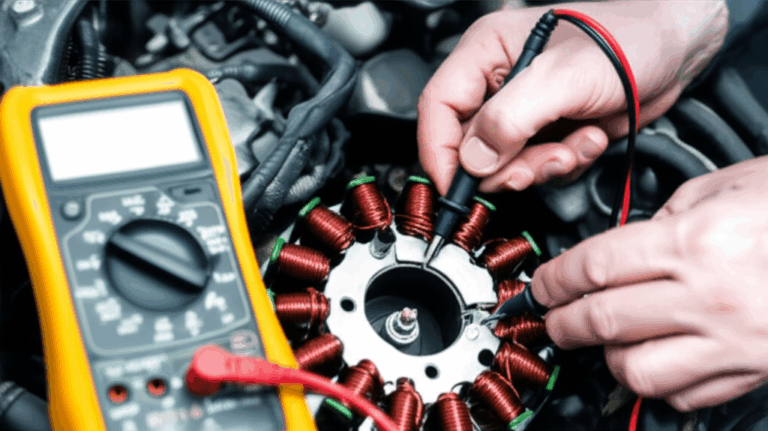
- Run FEA to predict core loss density and electromagnetic vibration. Confirm with accelerometer data.
- Keep a case study file. Add thermal imaging, temperature sensor data, and vibration plots. This shows durability and thermal stability over time.
Wrap-up with PAS one more time
Problem: Core loss and noise drain your motor. They waste energy and hurt NVH.
Agitate: Heat builds up and degrades life. Noise spooks buyers. High losses kill range and raise bills.
Solution: Self-bonding electrical steel adds insulation and stiffness in one step. It suppresses eddy currents. It reduces stress and magnetostriction. It dampens vibration. You get a cooler, quieter, and more efficient motor.
You can take the next step now. Pick the right lamination grade and bonding coat. Lock in your cure process. Test and tune. Then enjoy the payoff.